
Photon Semiconductor Interactions
Topic Description
Photon–semiconductor interactions form the basis of optoelectronic devices such as LEDs, lasers, and solar cells. These interactions involve:
- Photon absorption: The process by which photons transfer their energy to electrons, generating electron–hole pairs in the semiconductor.
- Recombination: The process by which electrons and holes combine, releasing energy either as light (radiative) or heat (non-radiative).
- Bandgap type dependence: The efficiency and mechanism of photon interaction depend critically on whether the semiconductor has a direct or indirect bandgap.
Fundamental Processes
Absorption: Photons with energy greater than or equal to the bandgap
can excite electrons from the valence band to the conduction band, creating electron-hole pairs.Emission: Excited carriers recombine to release energy either as light (luminescence) or heat (non-radiative). The emission wavelength is determined by the bandgap energy: .
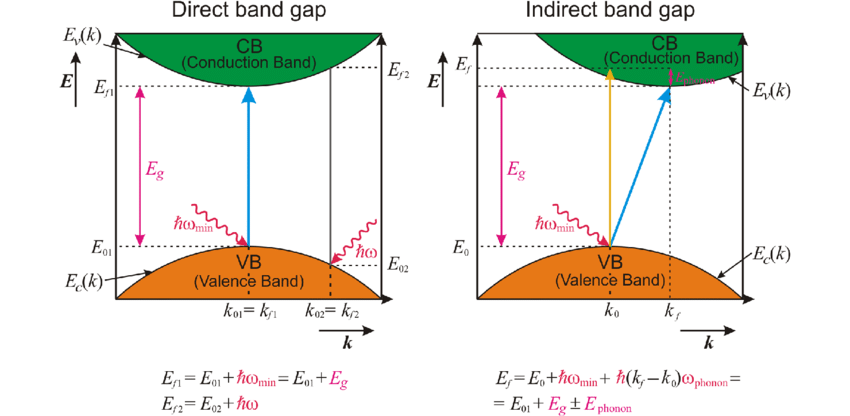
Direct vs. Indirect bandgap: In direct bandgap semiconductors (e.g., GaAs, InP), the conduction band minimum and valence band maximum occur at the same momentum value, enabling efficient radiative recombination. In indirect bandgap semiconductors (e.g., Si, Ge), momentum conservation requires phonon participation, making radiative recombination less efficient.
Photon Absorption
The absorption coefficient quantifies how strongly a material absorbs light of photon energy . It determines the penetration depth and absorption length of light in the semiconductor.
The intensity of light decreases exponentially with distance according to Beer-Lambert law:
where is the incident intensity and is the penetration depth.
Direct Bandgap Semiconductors
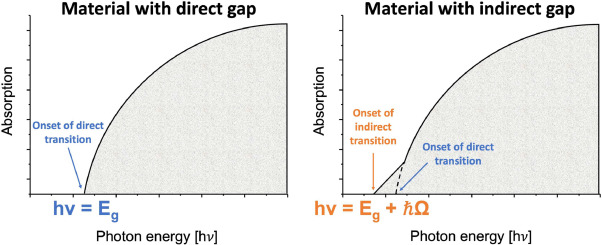
For direct bandgap semiconductors (e.g., GaAs, InP, GaN), vertical transitions dominate and the absorption coefficient varies as:
This square-root dependence results from the joint density of states for direct transitions. Direct bandgap materials have high absorption coefficients ( cm) near the band edge.
Indirect Bandgap Semiconductors
For indirect bandgap semiconductors (e.g., Si, Ge), phonon-assisted transitions are required to conserve momentum:
where is the phonon energy involved in the transition. The ± sign indicates phonon absorption (+) or emission (−). Indirect bandgap materials have lower absorption coefficients ( cm), requiring thicker layers for efficient absorption.
Emission Processes
When carriers recombine, photons may be emitted through various mechanisms:
- Spontaneous Emission (Luminescence): Random, independent photon emission when an electron in the conduction band recombines with a hole in the valence band without external stimulation.
- Stimulated Emission: An incoming photon triggers emission of another photon with identical phase, direction, energy, and polarization — the fundamental principle behind lasers and optical amplifiers.
- Non-radiative Recombination: Energy is released as heat through phonons instead of photons, reducing device efficiency.


Rate of Spontaneous Emission
The rate of spontaneous radiative recombination in semiconductors is given by:
where:
- and are the electron and hole concentrations
- is the intrinsic carrier concentration
- is the bimolecular recombination coefficient (also called radiative recombination coefficient)
This relation shows that net recombination occurs only when (excess carrier condition). Under thermal equilibrium, and .
Types of Luminescence
- Fluorescence: Rapid luminescence with short carrier lifetime ( ns), ceasing almost immediately when excitation stops.
- Phosphorescence: Delayed luminescence with long carrier lifetime ( µs–ms), persisting after excitation due to metastable trap states.
Light Amplification and Laser Action
Under population inversion (when , where and are upper and lower state populations), stimulated emission dominates over absorption, leading to light amplification. This is a non-equilibrium condition achieved through external pumping.
Requirements for Laser Operation
Laser (Light Amplification by Stimulated Emission of Radiation) operation requires:
- Population inversion: More carriers in the excited state than in the ground state
- Optical feedback: A cavity with mirrors providing resonance at specific wavelengths
- Sufficient gain: Optical gain must exceed all losses (absorption, scattering, mirror transmission)
The threshold condition for lasing is:
where is the gain coefficient, is the cavity length, represents internal losses, and , are mirror reflectivities.
Key Equations Summary
Beer-Lambert Absorption Law:
Direct Bandgap Absorption Coefficient:
Indirect Bandgap Absorption Coefficient:
Spontaneous Emission Rate:
Stimulated Recombination Rate:
Optical Gain: