
Optoelectronics: Photodiodes, LEDs, and Solar Cells
Optoelectronic devices exploit the interaction between photons and charge carriers in semiconductors to either:
- Generate electrical signals from light (photodetection), or
- Produce light from electrical energy (emission).
Three key devices form the foundation of this field:
- Photodiodes: Reverse-biased PN junctions where incident photons generate electron–hole pairs, producing a photocurrent.
- LEDs: Forward-biased PN junctions where injected carriers recombine radiatively, emitting photons.
- Solar Cells: Large-area photodiodes operated in photovoltaic mode to convert sunlight into electrical power.
Specialized variants include:
- Avalanche photodiodes
- CCD/CMOS image sensors
- Laser diodes
These extend optoelectronic principles to high-sensitivity detection, imaging, and coherent light generation.
Photon–Carrier Interactions
The fundamental processes in optoelectronic devices involve:
- Photon Absorption → A photon with energy ( h\nu \geq E_g ) excites an electron from the valence band to the conduction band.
- Carrier Generation & Separation → In the depletion region, the built-in electric field sweeps carriers toward opposite terminals.
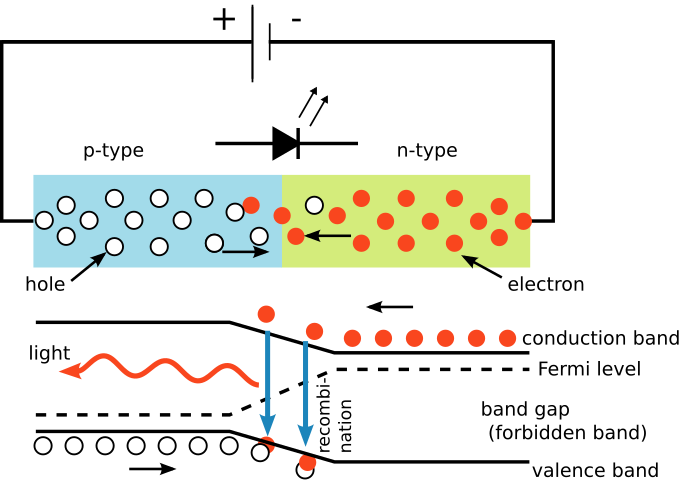
- Radiative Recombination → In direct bandgap semiconductors, electron–hole recombination releases a photon.
Photodiode Operation
For a reverse-biased photodiode, the total current is:
Where:
and the photocurrent is:
- ( \eta ) → Quantum efficiency
- ( P_{\text{opt}} ) → Incident optical power
- ( h\nu ) → Photon energy
For reverse bias ( V < 0 ), ( I_{\text{ph}} ) dominates.

LED Operation
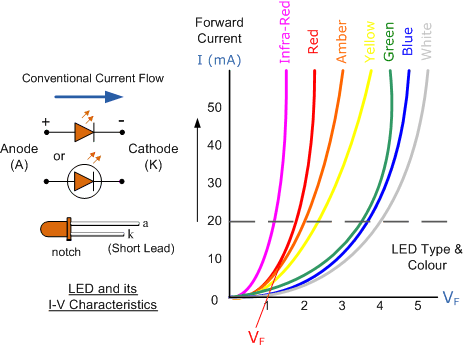
For a forward-biased LED, the injected carrier density determines the photon emission rate.
The internal quantum efficiency is:
Where:
- ( R_{\text{rad}} ) → Radiative recombination rate
- ( R_{\text{nonrad}} ) → Non-radiative recombination rate
The emitted optical power is given by:
Where ( \eta_{\text{ext}} ) is the external quantum efficiency, accounting for optical extraction losses.
Solar Cell Operation
A solar cell behaves as a large-area photodiode operated at zero or forward bias.
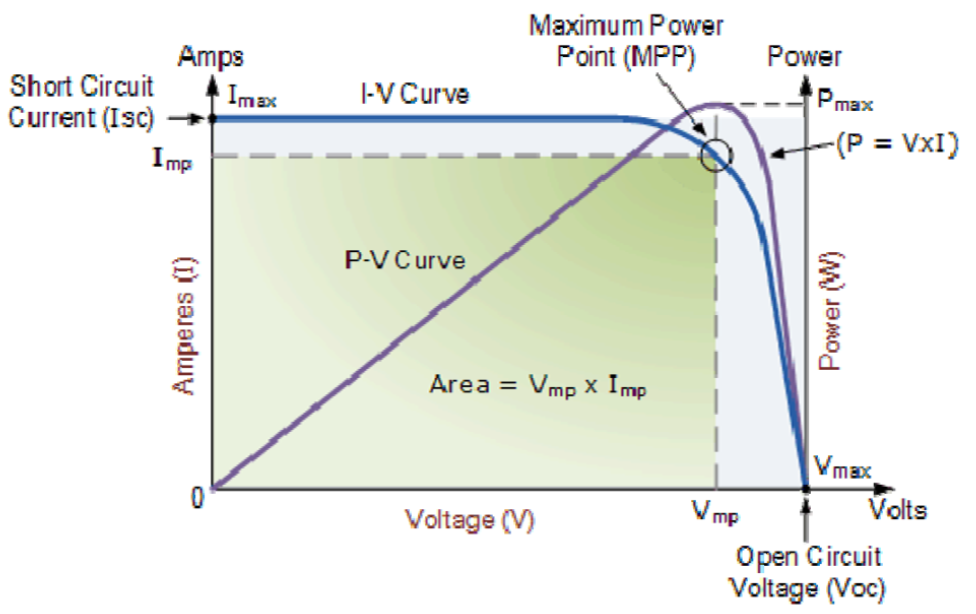
The illuminated I–V relationship is:
Key Performance Parameters
- Short-circuit current:
- Open-circuit voltage:
- Fill Factor:
- Efficiency:
Specialized Devices
- Avalanche Photodiode (APD): Reverse-biased beyond breakdown; carriers undergo impact ionization, giving high multiplication gain.
- CCD / CMOS Image Sensors: Use arrays of photodiodes for image capture.
- CCD: Uses charge transfer between pixels.
- CMOS: Uses per-pixel amplification.
- Laser Diode: Uses double heterostructures to confine carriers and photons, achieving stimulated emission and coherent light output.
Summary of Key Equations
Photocurrent:
Internal Quantum Efficiency:
Solar Cell Efficiency: