BJT Structure & Current Flow Visualization

VBE: 0.0V
VCE: 0.0V
IB: 0.0μA
IC: 0.0mA
Emitter (n+)
Base (p)
Collector (n)
Operation Mode
Cutoff
Current Gain (β)
0
Power Dissipation
0.0 mW
Transconductance
0.0 mS

Key Parameters

VBE(on)
0.70 V
Early Voltage
100 V
fT (Transit Frequency)
500 MHz

⚙️ Simulation Controls

0.00 V
0.0 V
10¹⁷ cm⁻³
1.0 μm
300 K
BJT Simulation: Adjust VBE and VCE to explore different operating modes. Watch the current flow animations and observe how device parameters affect performance.

BJT Characteristic Curves Analysis

Output Characteristics (IC vs VCE)
Input Characteristics (IB vs VBE)
Transfer Characteristics (IC vs IB)
Temperature Effects (IC vs VBE)
I-V Characteristics: Study how BJT current-voltage relationships change with different bias conditions, temperature, and device parameters. These curves are fundamental to BJT circuit design.

BJT Applications - Common Emitter Amplifier

Common Emitter Amplifier

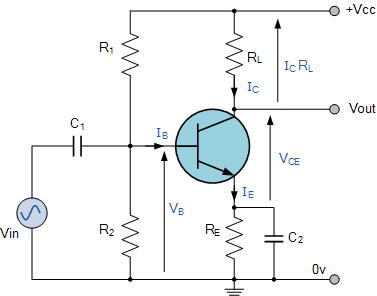
Common Emitter Amplifier Circuit

Standard Common Emitter Amplifier Circuit

Amplifier Parameters
Current Gain
50
Phase Shift
180°
Input Amp
0.1V
Output Amp
5.0V

Input/Output Waveform Simulation

Input Signal (Vin)
Output Signal (Vout)

📚 CE Amplifier Theory

  • High Voltage Gain: 50-200
  • Phase Inversion: 180° shift
  • Input Impedance: 1-5 kΩ
  • Output Impedance: 1-10 kΩ
  • Bias: Set for linear operation
  • RC: Determines voltage gain
  • RE: Provides stability
  • Coupling Caps: Block DC, pass AC

The CE amplifier uses the BJT's current control property. Small base current changes produce large collector current changes, creating voltage amplification across RC. The 180° phase shift occurs because increasing base current decreases collector voltage.

  • Audio preamplifiers
  • Signal conditioning
  • Driver stages
  • RF amplifiers
BJT Applications: The Common Emitter configuration is the most widely used BJT amplifier circuit. It provides excellent voltage gain and is the building block for many electronic systems.

BJT Physics Knowledge Challenges

5
Total Challenges
0
Completed
0
Score

Click to reset all challenges with different questions from the BJT physics question bank

1

Welcome to BJT Lab

Welcome to the BJT Physics Lab! This guided tour will walk you through all the features of this simulation.

Help & Information

Quick Guide:

Simulation: Adjust VBE/VCE to explore BJT operating modes and observe current flow animations.

I-V Characteristics: Study comprehensive BJT characteristic curves including output, input, transfer, and temperature effects.

CE Amplifier: Interactive waveform simulation with real-time controls. Upload your own circuit diagrams for reference!

Challenges: Test your knowledge with interactive exercises including matching, fill-in-blanks, and calculations.

Key BJT Concepts:

Operating Modes: Cutoff, Active, Saturation, Reverse Active

Current Gain (β): IC = β × IB in active mode

Early Effect: Output resistance in active region

Temperature Effects: VBE decreases ~2mV/°C

CE Amplifier Features:

🎛️ Interactive Controls: Adjust amplitude, frequency, and gain in real-time

📊 Live Waveforms: See input/output signals with 180° phase shift

🖼️ Circuit Upload: Add your own CE amplifier circuit diagrams

🎯 Drag & Drop: Simply drag image files to upload

Challenge Features:

🎯 Multiple Types: True/False, Multiple Choice, Fill-in-blanks, Matching, Calculations

🏆 Scoring System: Earn points for correct answers

💡 Detailed Explanations: Learn from mistakes with comprehensive feedback

📊 Progress Tracking: Monitor your learning progress